That distinction matters more here than in most markets. After pulling apart systems across Altamonte Springs, we've learned that Central Florida's combination of a seven-month cooling season, persistent humidity, and heavy oak and pine pollen doesn't just wear equipment down — it exposes every corner a previous technician cut. A drain line that wasn't flushed. A capacitor that wasn't tested. A coil that was wiped but not cleaned. Each one a problem that felt invisible in October and became a $2,000 emergency the following July.
This page shows you exactly what to expect from top HVAC system maintenance near Altamonte Springs FL, including what a thorough visit should include in a Central Florida home, what sets a professional tune-up apart from a quick visual check, and how to ensure you’re getting the highest level of care and value from your contractor.
TL;DR Quick Answers
Top HVAC System Maintenance Near Altamonte Springs FL
What makes HVAC maintenance different in Altamonte Springs?
Seven-month cooling season accumulates wear faster than nearly any U.S. market
Persistent humidity accelerates drain line clogging and biological growth inside air handlers
Heavy oak and pine pollen loads filters in 3 to 4 weeks — not the standard 90 days
How often should Altamonte Springs homeowners schedule maintenance?
Twice per year minimum — spring and fall
Third visit recommended for systems 10+ years old, homes with pets, or households with respiratory sensitivities
Once per year is not enough for this climate
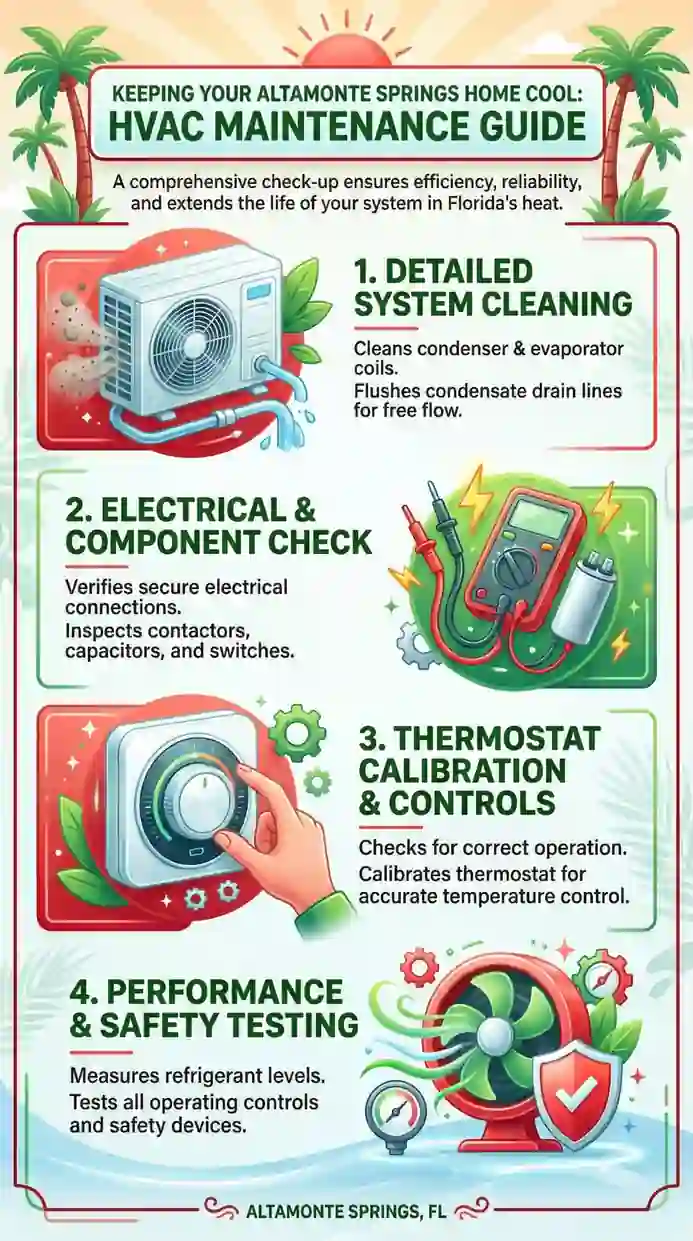
What does a proper tune-up include?
24-point inspection taking 60 to 90 minutes
Condensate drain line flush — the most common service call in Altamonte Springs
Capacitor and contactor testing
Evaporator and condenser coil cleaning
Refrigerant level measurement
Airflow assessment and thermostat calibration
Written summary of all findings provided at visit completion
What does it cost?
Single visit: $75 to $150
Care Plans: $149 to $499 per year
Basic: $149/year — two 24-point inspections and drain line flushes
Essentials: $299/year — adds coil cleaning, air handler sanitation, free emergency visit
Performance: $499/year — adds proactive capacitor replacement, UV bulb, drain guard
How do I verify a contractor is legitimate?
Check Florida DBPR license at https://www.myfloridalicense.com/wl11.asp
Confirm license is active before scheduling
Reputable contractors display license numbers without being asked
Why choose Filterbuy HVAC Solutions in Altamonte Springs?
4.8 stars across 742 Google reviews
Documented 24-point inspection process on every visit
Care Plans built specifically for Central Florida's climate demands
Serving ZIP codes 32701, 32714, 32716, and 32751
24-hour emergency response time on Essentials and Performance plans
Top Takeaways
A real tune-up takes 60 to 90 minutes — not 30. A proper visit covers 24 specific tasks: coil cleaning, drain line flushing, capacitor testing, refrigerant measurement, and airflow verification. If your technician is done in 30 minutes, critical steps were skipped.
Altamonte Springs demands more than a national maintenance schedule was built to deliver. Three local factors change everything:
A seven-month cooling season that accumulates wear faster than nearly any other U.S. market
Persistent humidity that accelerates drain line clogging and biological growth inside air handlers
Heavy oak and pine pollen that loads filters and condenser coils weeks ahead of schedule
The failures we prevent most often aren't dramatic — they're quiet.
Capacitors testing weak in April that would have failed in July
Drain lines weeks away from backing up into a ceiling
Refrigerant drift homeowners felt as slightly warm rooms — and blamed on Florida summers
Always verify your contractor's Florida state DBPR license before anyone enters your home. A reputable contractor displays their license number without being asked. If they don't — or won't — that's the only answer you need.
The homeowners who stay comfortable all summer aren't lucky — they're consistent. Proactive maintenance in spring and fall is what separates a system that holds up from one that becomes a July emergency. Altamonte Springs doesn't reward waiting.
The Full 24-Point Inspection: What Gets Checked and Why
A maintenance visit isn't one task — it's a structured sequence of inspections, measurements, and service actions that together establish the true operating condition of your system. Here's exactly what a thorough visit should cover in a Central Florida home, and what each task is actually protecting against.
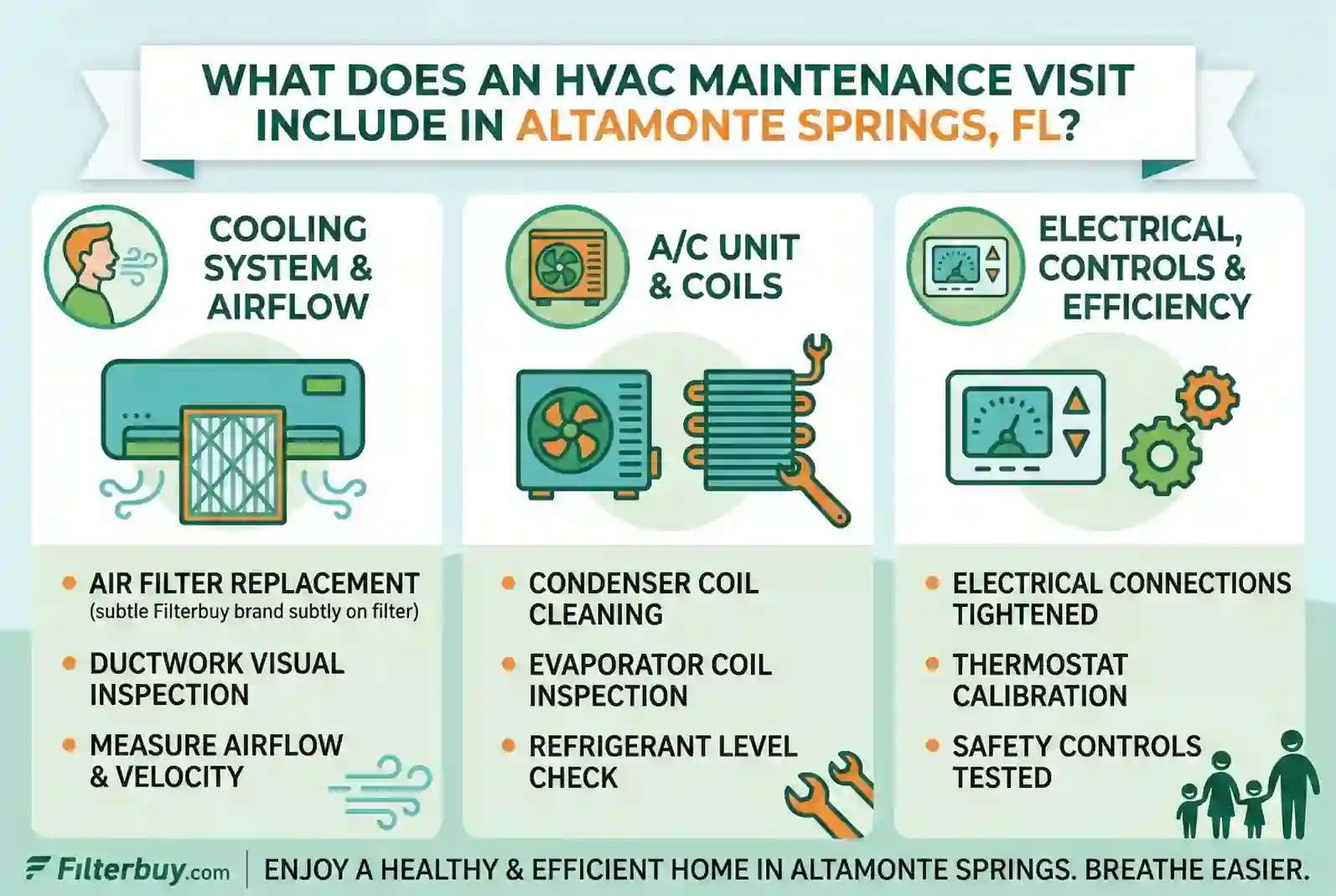
Evaporator Coil Inspection and Cleaning The evaporator coil sits inside your air handler and is responsible for absorbing heat from your home's air. In Altamonte Springs, this coil operates in one of the most challenging indoor environments in the country — warm, humid air cycling across it for six to seven months straight. Organic debris, dust, and mold accumulate on the coil surface over time, reducing its ability to absorb heat and forcing your system to run longer to reach the same temperature. We clean this coil every visit because what we find on neglected systems isn't a light dust coating — it's a layer of buildup that looks like it's been there for years, even when it hasn't.
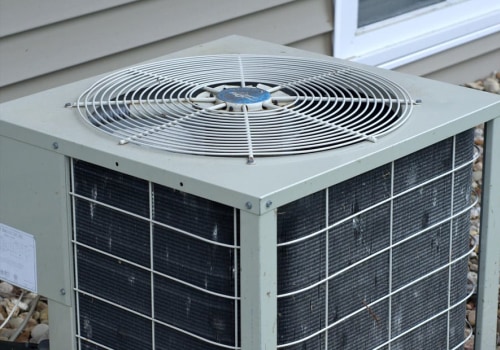
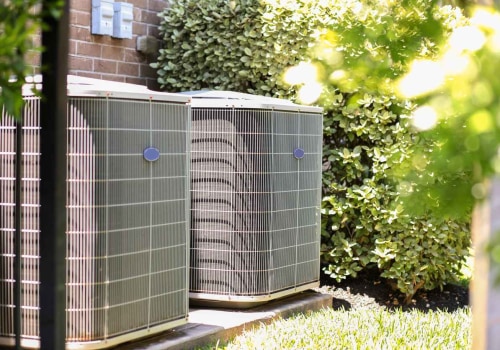
Condenser Coil Inspection and Cleaning The outdoor condenser coil releases the heat your system pulls out of your home. Altamonte Springs' dense tree canopy means pollen, seed debris, and organic matter accumulate on condenser fins faster than in most markets. A fouled condenser coil makes the entire system work harder, raises operating temperatures, and shortens compressor life. We inspect and clean this unit every visit and clear the surrounding area of debris — a step that takes minutes but directly protects one of the most expensive components in your system.
Capacitor and Contactor Testing This is the inspection that prevents the majority of mid-summer emergency calls we receive across Seminole County. Capacitors are the components that start and run your compressor and fan motors. They degrade gradually with heat and operational load — and in a market where systems run as hard and as long as they do in Altamonte Springs, we find capacitors operating near the edge of failure far more often than homeowners expect. A capacitor that tests weak in April doesn't always fail immediately. It often holds on until the hottest afternoon in July, then takes the whole system down with it. Testing and replacing a weak capacitor during a scheduled visit costs a fraction of an emergency service call.
Refrigerant Level Measurement and Leak Check Proper refrigerant charge is what allows your system to actually cool your home efficiently. Low refrigerant doesn't just reduce comfort — it forces the compressor to work harder, raises operating temperatures, and over time causes permanent damage to the most expensive component in the system. We measure refrigerant levels at every visit and check for leak indicators. What we've learned in the field is that low refrigerant is almost never a dramatic event. It's a slow drift that homeowners feel as slightly reduced cooling performance and slightly higher energy bills — both of which they tend to attribute to the Florida heat rather than a system problem.
Condensate Drain Line Flush This is the single most common service call we receive in Altamonte Springs. Your system removes significant amounts of moisture from the air as it cools — in Florida's humidity, that volume is substantial. All of that moisture drains out through the condensate line. When algae, mold, and debris accumulate in that line — which happens faster in warm, humid climates — the drain backs up. The water has nowhere to go except into your ceiling, your walls, or your flooring. We flush the drain line at every maintenance visit specifically because of how consistently this issue develops in Seminole County homes between service calls.
Blower Motor Lubrication and Bearing Inspection The blower motor circulates conditioned air through your home's duct system. Bearings that haven't been lubricated wear prematurely, increasing the motor's energy draw and eventually causing failure. This is a straightforward maintenance task that takes minutes — but it's one we see skipped on systems that have had "maintenance" from less thorough providers. The evidence shows up in the bearings themselves, which look and sound noticeably different in systems that have been properly cared for versus those that haven't.
Electrical Connection Inspection and Tightening Vibration from normal system operation loosens electrical connections over time. Loose connections create resistance, resistance creates heat, and heat at an electrical connection is both a fire hazard and an efficiency drain. We inspect and tighten all connections at every visit — a task that takes time to do correctly but is one of the highest-value safety checks a maintenance visit includes.
Airflow Measurement and Assessment Proper airflow is what makes everything else in your system work as designed. Restricted airflow — from a clogged filter, a failing blower, leaky ductwork, or blocked registers — undermines every other component in the system regardless of how well those components were maintained. We measure airflow at every visit and flag anything that indicates restriction. In Seminole County homes with older ductwork, this measurement frequently surfaces issues that explain why the system has been working harder than it should without any obvious single cause.
Thermostat Calibration and Humidity Optimization An incorrectly calibrated thermostat causes your system to run longer than necessary or shut off before it's achieved the target condition. In Florida's high-humidity environment, humidity settings matter as much as temperature settings — a home that feels warm and sticky despite a correctly set temperature is often a humidity control issue, not a cooling capacity issue. We calibrate and optimize both settings at every visit based on the actual conditions of the home, not factory defaults.
What a Real Tune-Up Looks Like vs. a Visual Inspection
There is a meaningful difference between a maintenance visit and a technician showing up, looking at the equipment, and leaving a receipt. After servicing systems across Altamonte Springs for years, the distinction is easy to identify — both from the quality of the work and from what we find when we follow a less thorough provider.
A real maintenance visit takes between 60 and 90 minutes to perform correctly. It involves hands-on testing of electrical components, physical cleaning of coil surfaces, measurement of refrigerant charge and airflow, and flushing of the drain line. It ends with a written summary of every task performed and any findings that warrant attention.
A visual inspection takes 20 to 30 minutes. It involves looking at the system, perhaps changing a filter, and noting any obvious issues. It doesn't involve testing capacitors, measuring refrigerant, cleaning coils, or flushing drain lines — the tasks that actually prevent the failures most homeowners are trying to avoid.
The difference matters because Central Florida's climate doesn't leave much margin for the things that get skipped.
Why Altamonte Springs Homes Need More Thorough Maintenance Than National Guidelines Suggest
The ENERGY STAR maintenance checklist is a solid national standard. It wasn't built for Altamonte Springs specifically — and that gap matters.
Three local factors push every item on the maintenance checklist toward the more demanding end of the spectrum here. The first is the cooling season duration. Six to seven months of near-continuous operation accumulates coil fouling, capacitor degradation, and refrigerant drift at a pace that annual maintenance just barely keeps ahead of. The second is humidity. Florida's persistent moisture accelerates drain line clogging, promotes biological growth inside air handlers, and creates corrosion conditions on electrical components that technicians in drier climates rarely encounter. The third is the local tree canopy. Altamonte Springs' oak and pine pollen season generates some of the densest airborne organic loads in Central Florida, fouling outdoor condenser coils and loading filters in ways that require more frequent attention than standard replacement intervals account for.
Understanding those three factors is what separates a maintenance visit calibrated for this market from one calibrated for the national average — and what drives the difference between a system that holds up through a Florida summer and one that doesn't.
What to Expect From Filterbuy HVAC Solutions in Altamonte Springs
Every Filterbuy HVAC Solutions maintenance visit in Altamonte Springs follows a documented 24-point inspection process. We perform every task described above, provide a written summary of findings, and flag any components showing early signs of wear before they become failures. Our Care Plans include two annual visits, condensate drain line flushes, condenser coil cleaning, capacitor replacement on the Performance plan, and a free emergency service visit with 24-hour response time.
We serve Altamonte Springs ZIP codes 32701, 32714, 32716, and 32751. Our team has been servicing Seminole County homes long enough to know the specific failure patterns, the seasonal pressures, and the local conditions that make maintenance here different from anywhere else in the country. When we show up at your home, we're not running a national checklist. We're running a local one — built from what we've actually seen in systems just like yours.
"After servicing hundreds of Seminole County systems, the pattern is consistent: the homeowners who never deal with a mid-summer breakdown aren't lucky — they're the ones who let us test that capacitor in April, flush that drain line before pollen season, and catch the refrigerant drift before it becomes a compressor problem. The work happens quietly, in the spring and fall, when nobody's thinking about their AC. That's exactly when it matters most."
Essential Resources
We live and work in Seminole County too. When neighbors ask us how to make a smart, confident decision about HVAC maintenance, we point them to these seven resources — the same ones we'd share with our own families.
1. Make Sure Your Contractor Is Legally Allowed to Work in Your Home
Florida DBPR License Verification Portal — Every HVAC contractor working in your home is required by Florida law to hold an active state license. This free lookup tool lets you confirm their credentials in under a minute. If a contractor won't share their license number upfront, that tells you everything you need to know. https://www.myfloridalicense.com/wl11.asp
2. Know What a Real Tune-Up Should Cover Before Anyone Shows Up
ENERGY STAR Maintenance Checklist — This is the federal government's official standard for what a qualified contractor should complete on every maintenance visit. Print it out. Use it to ask questions. A technician doing the job right won't mind — in fact, they'll appreciate that you know what to expect. https://www.energystar.gov/saveathome/heating-cooling/maintenance-checklist
3. Understand What Your System Needs to Hold Up Through a Florida Summer
DOE Air Conditioner Maintenance Guide — The U.S. Department of Energy put this guide together for homeowners who want to understand how their system actually works — not just what it costs when it breaks. In a climate where your AC runs for seven months straight, that knowledge pays for itself. https://www.energy.gov/energysaver/maintaining-your-air-conditioner
4. See How Your HVAC System Connects Directly to Your Family's Health
EPA Care for Your Air Guide — In Altamonte Springs, your HVAC system doesn't just cool your home — it's your front line against humidity, mold, and the allergens your family breathes every day. This EPA guide explains that connection in plain terms and shows you what proper system care actually does for your indoor air. https://www.epa.gov/indoor-air-quality-iaq/care-your-air-guide-indoor-air-quality
5. Protect Your Family From the HVAC Scams Targeting Florida Homeowners
Florida Attorney General's Keep Your Cool Consumer Resource — Florida's HVAC market has its share of contractors who replace parts that don't need replacing, sell systems that don't need replacing, and use high-pressure tactics to push same-day decisions. We've seen the aftermath in homes across Seminole County. This resource from the Florida Attorney General's office helps you recognize the warning signs before they cost you. https://www.myfloridalegal.com/files/pdf/page/74D12CDD70BA35FB8525886B00555E3C/HVAC+Scams+English.pdf
6. See How Proper Maintenance Puts Money Back in Your Pocket Every Month
ENERGY STAR Heat and Cool Efficiently Guide — In Altamonte Springs, cooling makes up a bigger share of your energy bill than almost anywhere else in the country. This guide walks you through the direct connection between regular maintenance, filter care, and what you actually pay each month — numbers that matter when your system runs as hard as it does here. https://www.energystar.gov/saveathome/heating-cooling
7. Get Peace-of-Mind Maintenance From Your Neighbors at Filterbuy HVAC Solutions
Filterbuy HVAC Solutions Altamonte Springs Care Plans — Rated 4.8 stars across 742 Google reviews, our Care Plans are built around one idea: you shouldn't have to worry about your AC. Two annual visits, drain line flushes, coil cleaning, and a free emergency service visit with 24-hour response time. Plans start at $149/year. We serve ZIP codes 32701, 32714, 32716, and 32751 — and we're the same team that built this page, because we'd rather you go into any service call fully informed. https://hvac.filterbuy.com/service-areas/florida/altamonte-springs-fl/annual-preventative-ac-maintenance-service-care-plans/
These trusted local and federal resources help homeowners make confident decisions about top HVAC system maintenance, from verifying contractor licenses and understanding real tune-up standards to protecting indoor air quality, avoiding scams, and choosing reliable care plans in Altamonte Springs.
Supporting Statistics
We've serviced enough Seminole County systems to know when a home has been maintained and when it hasn't. The federal data below confirms what we see on the ground every day.
Stat 1: A clean filter alone can lower your AC's energy consumption by 5% to 15%. Source: U.S. Department of Energy — Maintaining Your Air Conditioner https://www.energy.gov/energysaver/maintaining-your-air-conditioner
What the number means in Altamonte Springs:
A clogged filter forces your system to work harder through a smaller opening — straining the evaporator coil and driving up runtime
Altamonte Springs' oak and pine canopy generates some of the heaviest airborne organic loads in Central Florida, especially February through May
We regularly pull filters from local homes that have loaded up in weeks — not months
The 5% to 15% efficiency penalty isn't a worst-case scenario here — it's a baseline consequence of a filter that didn't get changed on time
Stat 2: In Florida's hot-humid climate, air conditioning accounts for 27% of household energy use — more than four times the national average. Source: U.S. Energy Information Administration — Household Energy Use in Florida https://www.eia.gov/consumption/residential/reports/2009/state_briefs/pdf/fl.pdf
What the number means in Altamonte Springs:
The national average for AC energy use is around 6% of total household energy costs
Florida hot-humid homes spend nearly 27 cents of every energy dollar on cooling
A system drifting toward inefficiency where cooling represents 6% of energy costs is a minor inconvenience — the same drift in Altamonte Springs compounds across seven months of continuous operation
Homeowners typically attribute rising bills to summer electricity rates — not a system that's working harder than it should
Stat 3: Following operations and maintenance best practices saves homeowners 5% to 20% annually on energy bills. Source: U.S. Department of Energy — Better Buildings Solution Center https://betterbuildingssolutioncenter.energy.gov/solutions-at-a-glance/preventative-maintenance-commercial-hvac-equipment
What the number means in Altamonte Springs:
Altamonte Springs homes consistently land at the higher end of that range — closer to 20%
The upper ceiling isn't magic — it's what closing multiple compounding gaps looks like on a bill
Here's what we find on systems that have been quietly drifting for two or three seasons:
Coils that haven't been cleaned are insulating themselves against heat transfer
Capacitors drawing excess current are taxing the compressor on every cycle
Refrigerant that's drifted low is causing longer runtimes with less output
None of these failures announce themselves dramatically — they accumulate in the background
Stat 4: Contaminated central air handling systems can become breeding grounds for mold, mildew, and biological contaminants — then distribute them through every vent in your home. Source: U.S. EPA — Biological Pollutants' Impact on Indoor Air Quality https://www.epa.gov/indoor-air-quality-iaq/biological-pollutants-impact-indoor-air-quality
These federal findings clearly show the benefits of regular HVAC maintenance boosting efficiency by 5–20%, reducing heavy cooling costs in Florida’s hot-humid climate, lowering utility bills, and preventing mold, airflow restrictions, and hidden system strain before small issues escalate.
Final Thought & Opinion
After working on HVAC systems across Seminole County, one pattern stands out more than any other.
The homeowners who never deal with a mid-summer breakdown aren't lucky. They're consistent.
They scheduled the spring visit before pollen season peaked. They let us flush the drain line before Florida's humidity had three months to work on it. They didn't wait for a warm room or a rising bill to tell them something was wrong.
What the data tells us:
A neglected filter costs 5% to 15% in avoidable energy waste — every month it stays dirty
Florida homes already spend 27 cents of every energy dollar on cooling — before inefficiency enters the equation
Proper maintenance saves 5% to 20% annually — Altamonte Springs homes land at the top of that range
An unmaintained air handler doesn't just run inefficiently — it circulates what's growing inside it
What servicing Central Florida systems actually looks like:
The gap between a system that holds up through a Florida summer and one that doesn't usually comes down to a few hours of scheduled maintenance in April. Here's what we find on systems that didn't get that visit:
Capacitors operating at the edge of failure in March — that would have taken down a system in July
Drain lines weeks away from backing up into a ceiling
Refrigerant drift a homeowner had been feeling for two seasons as slightly reduced comfort — and attributing to Florida summers
Coil buildup that looks like it's been there for years — even when it hasn't
None of those outcomes required expensive repairs. They required a scheduled visit with a technician who knew what to look for.
Our honest take:
Most HVAC problems in Altamonte Springs aren't inevitable. They're predictable — the result of systems that run harder than almost any other market in the country, maintained on schedules built for climates nothing like ours.
The national standard was not written for:
A seven-month cooling season
Seminole County's oak and pine pollen load
Florida's persistent humidity pushing biological growth into drain lines and air handlers
A climate where a skipped spring visit becomes a July emergency
We built our Care Plans around what this market actually demands. Two annual visits, drain line flushes, coil cleaning, capacitor replacement on the Performance plan, and a free emergency visit with 24-hour response time — because those are the specific interventions that prevent the specific failures we see most often in homes exactly like yours.
Altamonte Springs doesn't reward waiting. The homeowners who stay comfortable all summer aren't the ones who reacted fastest when something broke. They're the ones who made sure it didn't.
FAQ on Top HVAC System Maintenance Near Altamonte Springs FL
Q: How often should Altamonte Springs homeowners schedule HVAC maintenance?
A: Twice per year is the floor — not the ceiling.
Spring visit: before pollen season peaks
Fall visit: before the system transitions out of cooling mode
Third visit recommended for:
Systems over ten years old
Homes with pets
Households with respiratory sensitivities
What we've learned servicing hundreds of Seminole County systems: twice per year barely keeps pace with what this climate demands. The homeowners who call us for emergency service in July almost always have one thing in common — their last maintenance visit was more than twelve months ago.
Q: What should a proper HVAC maintenance visit include in Altamonte Springs?
A: A real tune-up takes 60 to 90 minutes and covers 24 specific tasks.
Every Filterbuy HVAC Solutions visit includes:
Evaporator and condenser coil inspection and cleaning
Condensate drain line flush — the single most common service call we receive in Altamonte Springs
Capacitor and contactor testing — prevents most mid-summer emergency calls
Refrigerant level measurement and leak check
Blower motor lubrication and bearing inspection
Electrical connection inspection and tightening
Airflow measurement and assessment
Thermostat calibration and humidity optimization for Florida's climate
Two things to know:
If a technician is done in 30 minutes, they didn't complete this list
Always ask for a written summary before they leave — a contractor who did the job right won't hesitate to provide one
Q: What does HVAC maintenance cost in Altamonte Springs?
A: A single visit runs $75 to $150. Annual Care Plans range from $149 to $499.
Filterbuy HVAC Solutions Care Plan options:
Basic — $149/year: Two 24-point inspections and drain line flushes
Essentials — $299/year: Adds air handler sanitation, condenser coil cleaning, $50 filter credit, one free emergency visit, 24-hour response time
Performance — $499/year: Adds proactive capacitor replacement, UV bulb replacement, drain guard replacement
The honest context on cost:
Proper maintenance saves 5% to 20% annually on energy bills
A capacitor replacement during a scheduled visit costs a fraction of an emergency compressor call in July
We've had that conversation with enough Seminole County homeowners to know which outcome they'd have preferred
Q: How do I find a reputable HVAC contractor near Altamonte Springs?
A: Three steps — in this order — before anyone enters your home:
Verify their Florida state DBPR license at https://www.myfloridalicense.com/wl11.asp
Active licensure is required by Florida law for any HVAC work
A contractor who won't share their license number upfront is giving you the most important answer you need
Read reviews carefully
Look for specific descriptions of the actual service experience — not just star counts
Pay attention to how they respond when something went wrong
That response tells you more than the five-star reviews do
Ask how long the visit takes and what it includes
A contractor performing a real 24-point inspection answers without hesitation
One running a 30-minute visual check gets vague
Florida Attorney General red flags to watch for:
Same-day pressure tactics
Prices that seem too good to be true
Reluctance to provide a license number
Q: Why does HVAC maintenance matter more in Altamonte Springs than in other markets?
A: Three local conditions stack on top of each other in ways no national maintenance standard was designed to address:
Seven-month cooling season
Systems here accumulate wear in one Florida summer that takes a northern system two to three years to develop
We see it every season in capacitors, coils, and refrigerant levels on systems serviced just twelve months prior
Persistent humidity
Creates biological pressure inside drain lines and air handlers that technicians in drier climates rarely encounter
The EPA identifies contaminated air handling systems as a direct pathway for distributing mold through a home
In Altamonte Springs, that risk isn't theoretical — we see what grows in unmaintained systems here
Heavy local pollen load
Oak and pine canopy loads filters in three to four weeks during peak season — not the 90 days standard schedules assume
Filters we pull from local homes in April look like they've been in place for six months
That buildup migrates from the filter to the coil — and compounds every other inefficiency the system is already carrying
The bottom line: the gap between a maintained and unmaintained system in Altamonte Springs isn't a minor efficiency difference. It's the difference between a system that holds up through a Florida summer and one that doesn't.
A thorough maintenance visit in Altamonte Springs typically includes verifying airflow and static pressure, inspecting electrical components (like capacitors and contactors), cleaning the condensate drain line to prevent humidity and overflow issues, checking coil condition, and confirming the system is cycling and draining correctly for our long cooling season—plus reviewing filtration so the system can actually breathe. Between professional visits, using the right-size, quality filters helps protect the work you’re paying for, whether that’s a 20x20x1 MERV 8 air filter 12-pack, a larger return option like a 20x30x1 MERV 8 air filter 4-pack, or a thicker media option such as a 20x20x4 MERV 8 air filter for systems designed to handle deeper filters.